A ‘Healthy’ Facebook Pixel Can Still Be Losing You Money
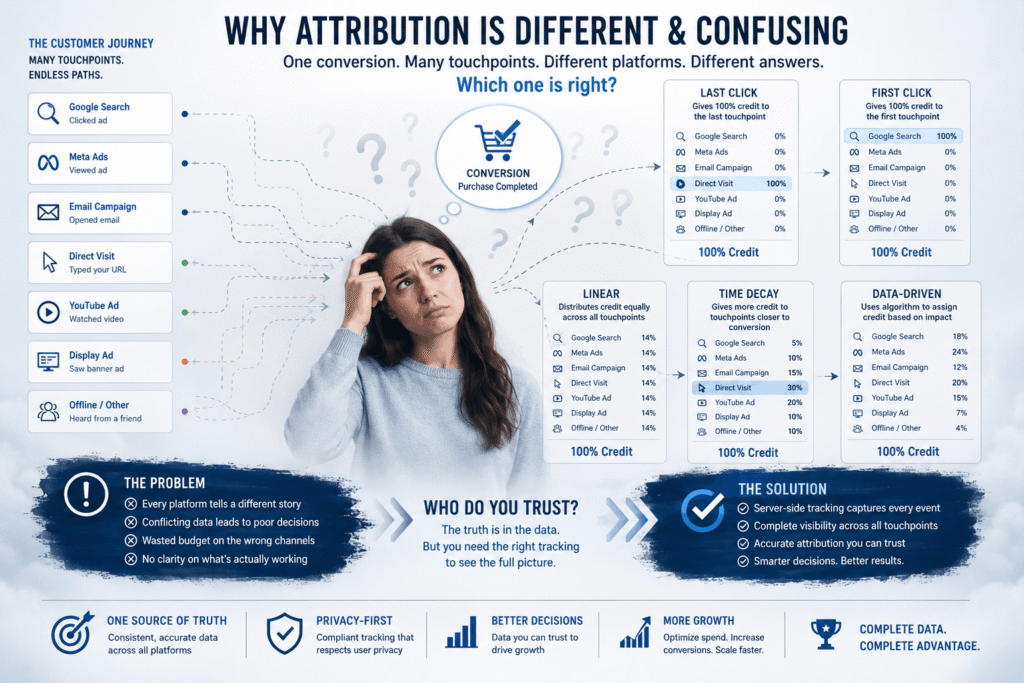
Your Facebook Pixel is installed. Events Manager shows it firing. No errors. You check your Ads Manager and conversions look roughly credible.
Then you check your CRM. The numbers are nowhere close.
A Facebook Pixel can look perfectly healthy and still miss a third of your conversions. Below: how to tell whether yours has a real problem, how to read your Event Match Quality score, why you need the Conversions API as well as the Pixel, and what the two 2026 attribution changes did to your numbers. Server-side tracking — which we set up for clients — is what closes the gap.
A healthy Pixel does not mean complete conversion tracking. These are two different things.
The Pixel fires for the sessions it can see. iOS restrictions, ad blockers, and cross-domain checkout flows mean a significant portion of your actual customers are invisible to it — even when every status indicator says it is working correctly.
If you’re here because your Facebook and Google Ads numbers simply don’t agree with each other — rather than a genuine shortfall against your CRM — that’s a structural difference, not a tracking failure. Start with why your platforms show different numbers.
How can you tell if Facebook has a tracking problem?
Compare Facebook reported conversions to your CRM sales for the same period. A healthy ratio post-March 2026 is 0.9–1.4× your CRM total. Below 0.6× of CRM sales indicates a Pixel or CAPI failure. Zero conversions reported means the Pixel is broken or no events are configured for the conversion you are tracking.
Note: healthy Facebook ratios shifted lower in 2026 following two platform changes (covered below). If you’re benchmarking against pre-2026 data, establish a fresh post-March 2026 baseline before diagnosing.
Before troubleshooting anything else, check your Event Match Quality score.
How do you check your Event Match Quality score?
Event Match Quality (EMQ) is Facebook’s score for how accurately it can match your conversion events to real users on the platform. Below 6.0/10 means Facebook cannot reliably identify who converted — affecting lookalike audience quality, algorithm efficiency, and the value of your conversion data. Find it in Meta Events Manager under your Pixel’s Overview tab.
Score meanings:
- 0–4: Poor. Facebook is getting minimal signal about who the converters are. Lookalike audiences built from this data are unreliable.
- 4–6: Needs improvement. Measurable impact on algorithm quality.
- 6–8: Acceptable. Room to improve.
- 8+: Target. Facebook can identify converters with high accuracy.
What lowers EMQ:
- Missing customer identifiers in the event payload — email, phone, name, city, country
- Running Pixel only, without CAPI (browser Pixel sends limited identity data)
- Events not deduplicating correctly
The fix: ensure CAPI is sending all available first-party identifiers alongside each purchase or lead event. Each additional identifier meaningfully improves the score.
EMQ is the single most actionable number in your Facebook tracking setup — most accounts have never looked at it.
Pixel or Conversions API — why do you need both?
The Facebook Pixel tracks browser-level events. The Conversions API (CAPI) sends conversion events server-to-server, bypassing browser restrictions entirely. Running both together, with proper deduplication, maximises event coverage and EMQ. The Pixel handles upper-funnel signals; CAPI ensures purchase and lead events are recorded regardless of ad blockers or iOS privacy settings.
In plain terms:
- Pixel: JavaScript running in the user’s browser. Ad blockers stop it. iOS privacy restrictions limit it. Fires for roughly 60–70% of actual conversions in typical UK accounts.
- CAPI: Your server sends the event directly to Facebook’s API. Nothing in the user’s browser can stop it. Fires on every transaction your server processes.
Running both requires deduplication. If both the Pixel and CAPI send a Purchase event for the same transaction, Facebook counts them twice unless you configure deduplication. Both events must include an identical event_id for the same transaction. Configure this in Meta Events Manager and verify the Deduplication column shows activity.
For service businesses and clinics using third-party booking platforms — where the booking confirmation page is on a different domain — the browser Pixel frequently misses conversions entirely because the Pixel code is not present on the third-party confirmation page. CAPI, configured to pull purchase or booking events from your backend, catches those regardless of where the booking completed.
What did iOS 14.5 take — and how does CAPI recover it?
Apple’s iOS 14.5 App Tracking Transparency (April 2021) removed the cross-app tracking identifier Facebook used to link ad impressions to post-click conversions on iPhone. Most iPhone users opted out. Facebook lost visibility into a large portion of iOS-originated conversions. CAPI recovers this by matching server-sent customer data (hashed email and phone) to Facebook account identity, bypassing the need for the blocked identifier.
In business terms: before April 2021, Facebook could see that an iPhone user who clicked your ad then purchased on your website. After iOS 14.5, for users who opted out, Facebook often cannot connect the ad click to the purchase. That conversion is invisible to the algorithm — affecting both reporting and campaign optimisation.
This gap is still present in 2026 for any account not running CAPI. It is not a temporary problem that will resolve itself.
Aggregated Event Measurement (AEM): Facebook’s framework for handling iOS conversions. You must configure your eight priority conversion events in Facebook’s AEM settings in order of business value. If not configured, Facebook’s ability to attribute iOS conversions is further reduced. Find this in Events Manager > Aggregated Event Measurement.
What are the two 2026 Facebook attribution changes — and what do they mean for your numbers?
Two separate changes hit Facebook accounts in 2026. Both reduced reported conversions. Neither indicates a decline in actual campaign performance. Check your CRM — if actual customer acquisition is stable, do not cut budgets or pause campaigns in response to lower Ads Manager figures.
January 12, 2026 — Attribution window removal
Facebook permanently removed the 7-day view and 28-day view attribution windows from the Ads Insights API. Only 1-day view remains for view-based attribution. Advertisers running awareness campaigns, video campaigns, or any campaigns where users typically convert more than 1 day after seeing (but not clicking) an ad saw reported conversions drop 15–40% overnight.
If your Facebook numbers dropped sharply around January 12, 2026, this is the cause.
March 3, 2026 — Click definition change
As confirmed in Facebook’s official announcement, Facebook changed its click attribution definition. Previously, any interaction with an ad — likes, reactions, shares, saves — qualified as a click for click-through attribution. From March 2026, only link clicks that bring a user to your site count.
Non-link interactions moved to a new category called engage-through attribution with a 1-day window. The critical detail: the previous engagement-based click-through attribution used a 7-day window. Engage-through only has 1 day. This means conversions where a user engaged with your ad (without clicking a link) and then converted on days 2–7 now fall outside any attribution window entirely — they did not simply move to engage-through, they left Facebook’s attribution entirely.
What this means for your reporting: click-through conversions dropped. A new engage-through column appeared. Some conversions that previously appeared under click-through are genuinely gone from Facebook’s reporting — not reclassified.
What this means for your business: actual customer acquisition is unchanged. Check CRM.
How do you diagnose tracking with Test Events in Meta Events Manager?
Facebook’s Test Events tool lets you trace live conversion events in real time — you can see whether the event fires, what data is being sent, and whether Facebook can match it to a user. Use this before assuming your tracking is broken.
How to use it:
- Meta Events Manager → your Pixel → Test Events
- Enter your live site URL
- Complete the conversion action you want to test (submit a form, complete a test booking, or add to cart)
- Watch the event appear in the right panel — confirm the Purchase or Lead event fires on the correct page
Also install the Facebook Pixel Helper Chrome extension to confirm browser-side Pixel firing. Note: Pixel Helper only confirms the browser Pixel, not CAPI. Use both tools together.
Common failure patterns Test Events reveals:
- Purchase event fires on the add-to-cart page instead of the order confirmation page
- No Purchase event fires at all — Pixel code missing from thank-you page
- Third-party checkout (PayPal Express, Klarna hosted checkout, booking platform) redirects to its own confirmation page — Pixel never fires
What causes zero conversions in Facebook?
- Pixel code missing from the thank-you page — Events Manager may show the Pixel as active (because it fires on other pages) but it has never seen the confirmation URL
- Third-party checkout bypasses the website — PayPal Express, hosted payment pages, and third-party booking platforms redirect users to their own confirmation screen, not yours
- Purchase event fires too early — triggered on add-to-cart or checkout initiation, not on purchase confirmation
- CAPI not configured — Pixel alone is missing iOS conversions by default; without CAPI there is no server-side recovery
- Custom conversion rule broken — URL-based custom conversion set up with a rule that no longer matches the actual thank-you URL after a site update
Frequently asked questions
Low EMQ means insufficient customer data is being sent with the conversion event. At minimum, send hashed email. Ideally also send hashed phone number, first name, last name, city, and country. Each additional identifier improves the score. CAPI, configured to pull identifiers from your backend at the point of purchase or booking, is the most reliable way to improve EMQ consistently.
They will be counted twice without deduplication. Deduplication requires both the Pixel and the CAPI call to send an identical event_id for the same transaction. Facebook checks for matching event IDs and counts them as one event. Check in Events Manager → your Pixel → Events → the Deduplication column. A healthy deduplication rate confirms both systems are sending and properly deduplicating.
Two changes are relevant. If the drop was around January 12, 2026 — the 7-day and 28-day view attribution windows were removed from the API. If it was March 2026 — the click definition changed, with engagement interactions moving to engage-through (1-day window). Check your CRM for both periods. If actual customer acquisition held steady, both are reporting corrections.
No. Best practice is to run both. The Pixel handles page views, add-to-cart, and upper-funnel signals that help Facebook understand audience behaviour and build lookalike audiences. CAPI handles purchase and lead events where accuracy is critical. Removing the Pixel entirely loses upper-funnel signals. Running CAPI alone works for conversion recording but weakens full-funnel optimisation.
Two approaches. First: check the platform’s native Facebook integration — Shopify, Cliniko, Acuity, and most major booking platforms have built-in CAPI or Pixel integrations. This is the lowest-effort path. Second: server-side CAPI configured to pull purchase or booking events from your backend or CRM, sent directly to Facebook with customer identifiers. This works for any platform regardless of native support. See our guide on server-side tracking for what this involves.
If your Facebook Pixel numbers don’t match your CRM — and you’re not sure what’s being missed — we’ll audit your tracking setup and show you exactly what you’re losing.
Get a free tracking audit →Running Google Ads alongside Facebook? If Google Ads conversions are also missing or mismatched, see the Google Ads conversion tracking troubleshooting guide.
Bons & Frazer provides Facebook Ads management for Norfolk businesses and Google Ads for Norfolk businesses with server-side tracking built in from day one.
Related guides
Related: Event Match Quality below 7? The CAPI fix.
Bons & Frazer is a performance marketing agency based in Norwich specialising in Google Ads, Facebook Ads, and tracking infrastructure for service businesses and clinics. Check your EMQ score right now in Events Manager — if it’s below 6.0, you’re running campaigns on compromised data. We’ll audit your setup and show you what you’re missing.