
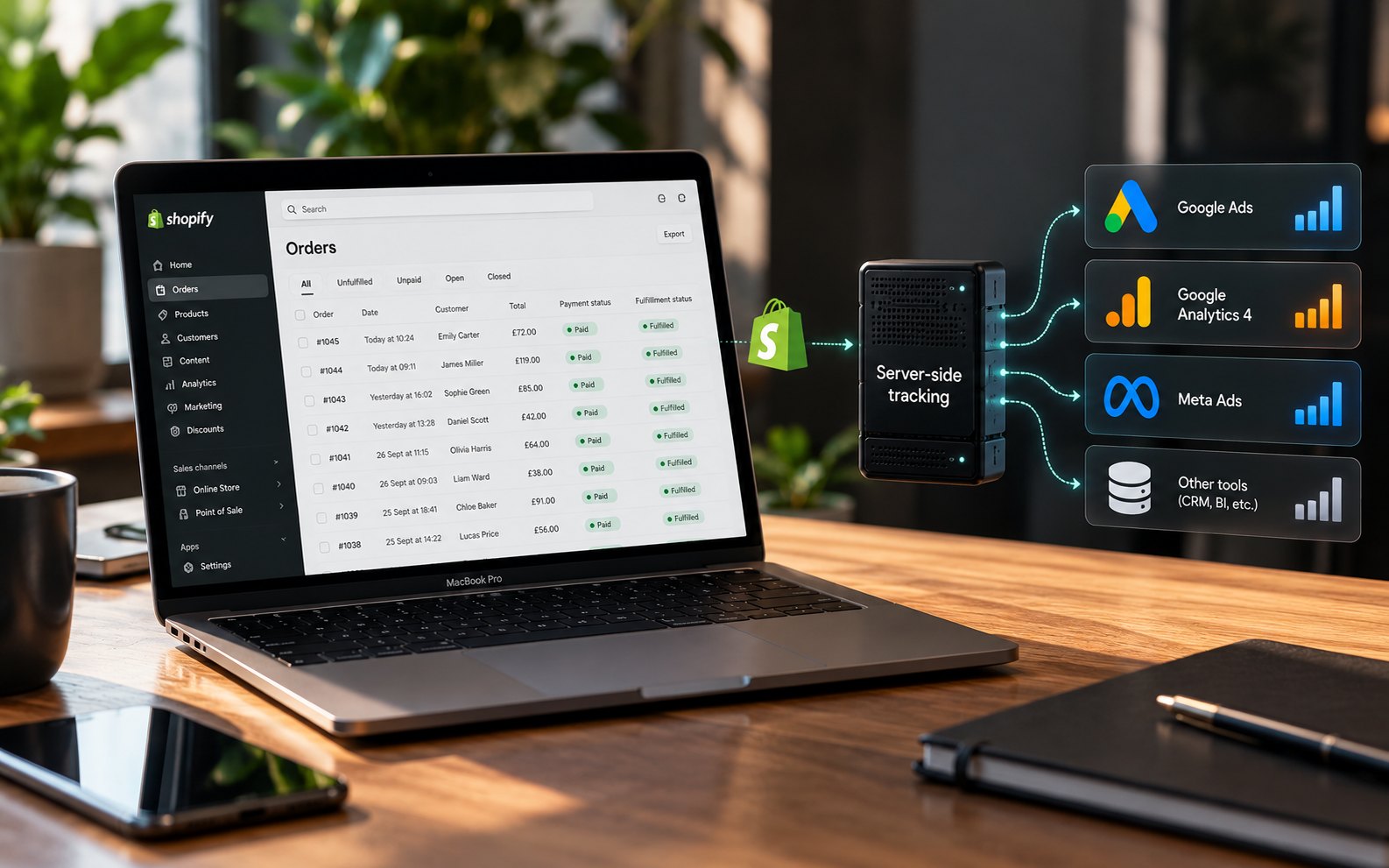
If your Shopify store reports fewer Google Ads or Meta conversions than your actual order count, you’re losing data to browser tracking limits — and on Shopify it’s especially common because checkout often sits on a Shopify-owned domain. Server-side tracking is the fix. This guide explains why Shopify leaks conversions and how to recover them.
Why is Shopify conversion tracking not working?
Shopify conversions leak for two reasons: browser-level blocking (ad blockers, Safari ITP, iOS) strips client-side pixels, and the checkout frequently runs on a different domain than your storefront, breaking the conversion path. The result is Google Ads and Meta under-reporting real orders.
You can confirm the gap in minutes: compare your last 30 days of Shopify orders against what Google Ads and Meta report. If the platforms show under ~70% of real orders, you have a recoverable tracking problem — the same diagnostic we cover in our guide to why Google Ads, Meta and GA4 conversions don’t match.
How does server-side tracking fix it on Shopify?
Server-side tracking collects the order event on a server you control and forwards it to Google Ads (via Enhanced Conversions) and Meta (via the Conversions API), bypassing the browser blocking that drops client-side pixels. It captures conversions the pixel never sees.
For Shopify specifically, this means hooking into the order/checkout data server-side rather than relying on a pixel firing in a checkout iframe the browser may block. Running the pixel and the server event together, deduplicated by a shared event ID, gives the most complete picture without double-counting.
What does it recover, realistically?
In our client work, server-side tracking typically recovers 15–25% of lost attribution — not the inflated 30–40% some vendors claim. On a Shopify store spending meaningfully on ads, even the low end is significant, and the bigger win is that Smart Bidding finally optimises against complete data.
We’re deliberately conservative here. The honest numbers and what server-side tracking does and doesn’t do are covered in full in our server-side tracking guide.
Doesn’t Shopify’s native channel integration already do this?
Shopify’s built-in Google and Meta channels help, but they rely on the same browser-side signals that ad blockers, Safari ITP and iOS strip — so they inherit the leak rather than fix it. A proper server-side setup with Enhanced Conversions and the Conversions API captures orders the native pixel never sees. On the Meta side, that leak shows up as the usual Facebook Ads conversion tracking problems.
The native apps are a sensible baseline and worth keeping. But they were built for coverage, not completeness — they fire client-side and don’t enrich events with first-party data the way a dedicated server-side configuration does. On a store spending seriously on ads, the gap between “connected” and “correctly tracked” is exactly the 15–25% of attribution most owners assume they already have.
How do you set it up without breaking checkout?
You capture the order event server-side — from Shopify’s order data or the Customer Events API — and forward it to Google and Meta with a shared event ID, running alongside the existing pixel rather than replacing it. Done correctly, the customer never sees a change and nothing in checkout is touched.
The deduplication is the part that goes wrong most often: pixel and server event must share one event ID, or you double-count and over-report. As part of our tracking setup service, we test every event end to end before going live, then reconcile a week of orders against the platforms to confirm the numbers line up — the same diagnostic discipline we use for fixing Google Ads conversion tracking.
Frequently asked questions
Shopify’s native integrations help, but they don’t fully replace a properly configured server-side setup with Enhanced Conversions, Meta CAPI, Consent Mode v2 and first-party enrichment — especially for accurate deduplication and Event Match Quality.
Yes. A correct server-side setup captures the order event regardless of which domain the checkout sits on, which is exactly the gap that breaks client-side pixels on Shopify.
No. Server-side tracking can be implemented on standard Shopify plans, though the exact method depends on your checkout configuration and apps.
We build server-side tracking for Shopify stores — Enhanced Conversions, the Conversions API and clean deduplication — so Google and Meta finally see your real orders. No pressure: we'll show you the gap first, then tell you if it's worth fixing.
Fix your Shopify tracking →Bons & Frazer runs Google Ads management and Meta Ads management for UK businesses on a fixed monthly fee, with server-side tracking built in. You deal directly with the two founders, with no contracts and no account managers. Based in Norfolk? See Google Ads in Norwich.