Half Your Conversions Are Invisible to Google and Meta. Here’s Why — and the Fix.
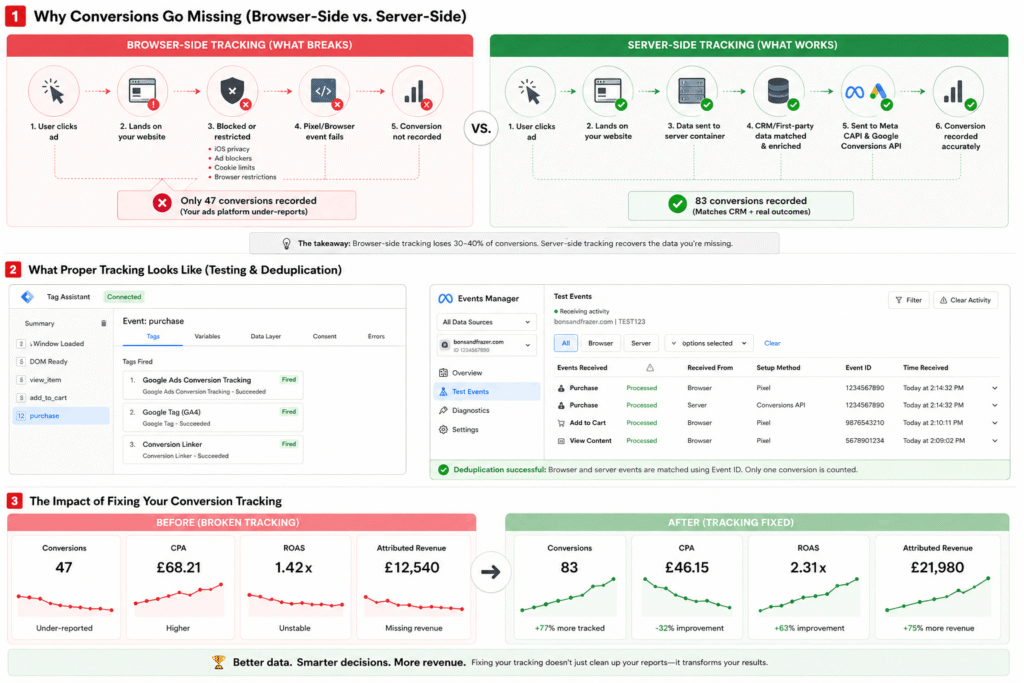
Google reports you generated 47 conversions last month; your CRM says you generated 83 sales. Your agency says everything is correct. Both Google and the agency say tracking is working properly. Yet 36 of those conversions — almost half of all actual customers — are completely invisible to the people who are trying to optimise your campaigns.
This is not a glitch. It has been structural and growing worse each year since 2021. Here’s what is happening and how you fix it.
Why your ads tracking is failing (and it still looks like it works)
Ad tracking uses a small piece of Javascript code that runs inside the user’s browser when the user completes a conversion action. This Javascript sends the conversion to either Google or Meta. Then Google or Meta records the conversion.
This worked well enough for 10 years. But once browsers started blocking Javascript, it stopped working. Safari added Intelligent Tracking Prevention. Firefox followed. Apple released iOS 14.5 with App Tracking Transparency — most users turned it on. Ad blockers now affect approximately 40 percent of all desktop browsers in the United Kingdom.
Your pixel will only see a fraction of the conversions taking place. The customer made a purchase. Your server knows. But the tracking script may not have fired, so neither Google nor Meta record it.
A pixel reporting “no errors” is not the same as the pixel capturing every conversion. A pixel can be technically healthy and still miss 30–40% of your actual sales.
Left: browser pixel blocked by iOS and ad blockers. Right: server-side reaches the platform directly.The real effect of missing conversions on your campaign
Both Google and Meta utilise machine learning for their Smart Bidding and advertising algorithms. Machine learning uses historical conversion data to determine future bidding. When these algorithms are learning from incomplete data, if half of your actual customers are invisible to these platforms, the algorithm receives poor quality signals upon which to base decisions.
These platforms create Lookalike Audiences from their partial view of your customers. They adjust bids based on inaccurate performance metrics. They fund campaigns less due to apparent unprofitability — despite potential profitability — since the platform cannot view the actual conversions.
The campaigns that are underfunding themselves are generally profitable. They simply are not visible.
We partnered with a private scanning clinic that ran a Meta campaign for three months prior to consulting with us — a campaign that indicated a continuous loss on every metric in Ads Manager. The client used a subdomain booking application, so the Facebook Pixel recorded ad clicks but never received information regarding subsequent bookings. Their Event Match Quality Score stood at 4.2.
Upon implementing server-side CAPI and pulling booking data directly from their backend — closing the subdomain tracking gap — reported conversions increased by 38% in the first four weeks. Event Match Quality improved to 8.1. The campaigns remained unchanged. Spend remained unchanged. Patients continued to book — the system simply could not measure them.
What server-side tracking actually is
For Google Ads this happens via Enhanced Conversions — your server sends hashed customer data (email, phone) along with the conversion event, and Google matches it back to the initial ad click. For Meta, it is the Conversions API (CAPI) — designed to work alongside the browser pixel rather than replacing it.
Three signs your tracking is currently broken
1. Large gap between GA4 and platform conversions
In GA4, look at your purchase or lead events over the last 30 days. Compare to Google Ads conversions for the same period. A large disparity in either direction indicates a breakdown somewhere in your attribution chain.
2. Meta Ads Manager purchases don’t match your CRM
Compare reported purchases in Meta Ads Manager against actual purchases in your CRM, Shopify, or booking system for the same time period. A discrepancy larger than 15–20% is a tracking issue. Larger than 30% means you are losing money from campaigns that perform better than your data shows.
3. Unexplained week-to-week ROAS swings
Large ROAS fluctuations with no changes to budgets, creatives, or seasonality indicate tracking instability, not real performance variation. The algorithm is reacting to noise, not signal.
A note on Meta’s March 2026 attribution change
Prior to conducting the diagnostic below, there is one important context item to understand for everyone reviewing Meta data after March 2026.
Meta changed its definition of click-through attribution in March 2026. Prior to this, any ad click — likes, reactions, comments, shares — qualified for click-through attribution. A user who tapped the heart icon on your sponsored post and then purchased within seven days would have been counted as a click-through conversion by Meta, even though they never clicked the link.
As of March 2026, only link clicks that bring a user to your site qualify. Meta stated this change was designed to reduce the gap between its numbers and third-party analytics tools like GA4.
The practical implication: if your Meta conversion numbers or ROAS dropped from March 2026 onward and you made no campaign changes — do not cut Meta spending. Do not interpret lower Ads Manager numbers as evidence that Meta stopped working. The lower numbers are now the accurate numbers. A drop in Meta conversions from March 2026 onward is not the same indicator of a tracking issue as a genuine tracking failure.
The urgency of Consent Mode v2 in 2026
As soon as a user refuses consent on your cookie banner, your standard Google tag fires in a “declined” state. With Consent Mode v2 properly configured, Google uses modelling to estimate conversions from declined-consent users based on patterns from users who consented. That modelled data feeds into Smart Bidding.
Declined-consent users are invisible without Consent Mode v2. There is no modelling. There is no data. A large blind spot — and a compliance risk.
Server-side tracking and Consent Mode v2 work in unison. Server-side captures the conversions that can be measured. Consent Mode provides the statistical model for those that cannot. Running either without the other means leaving money on the table.
Diagnosing your own tracking gap in 15 minutes
An agency is not required to run this check.
- 1In GA4 — Reports > Monetisation > eCommerce Purchases (or Events for lead forms). Record your conversion total for the last 30 days.
- 2In Google Ads — Campaigns > Columns > Conversions for the same period. More conversions than GA4 suggests duplicate tracking. Fewer suggests conversions are being lost in your attribution chain.
- 3In Meta Events Manager — open your pixel and check Event Match Quality (EMQ) for your purchase or lead event. Below 6.0/10 is materially damaging campaign performance. 8.0+ is the target.
- 4Cross-reference all figures against your actual backend data — CRM, Shopify, or booking system. The gap between what the platforms report and what actually occurred is your tracking loss.
What a complete tracking solution looks like
Server-side Google Tag Manager (sGTM)
A cloud-hosted server container that sends events from your site to Google Ads via Enhanced Conversions and to GA4 via server-side tags. Your core conversion events become completely server-dependent — the browser is out of the loop for the conversions that matter.
Meta Conversions API (CAPI)
Sends server-side purchase and lead events directly to Meta — in addition to your browser pixel. The pixel handles page views and upper-funnel events. CAPI handles conversion events that affect campaign optimisation. Running both requires deduplication via a shared event ID — otherwise the same conversion is counted twice.
Consent Mode v2
Properly integrated with a Google-certified CMP so that when a user declines consent, tags default to denied, consent signals update dynamically, and modelling activates for declined-consent users. This creates the greatest possible measurable view of your business constrained by current privacy law.
First-party data enrichment
Send additional customer identifiers — hashed email, phone number, first name, last name — with your conversion events to increase Google’s Enhanced Conversion match rates and Meta’s Event Match Quality. The more accurately each platform can connect your events to logged-in customers, the better the algorithmic learning.
The algorithmic impact of complete conversion data
You’ve probably already noticed how server-side tracking affects targeting — but this is often overlooked while most advertisers focus on it solely as a means of getting accurate numbers and seeing real ROAS.
The biggest impact of server-side tracking is on the algorithms within both Google’s Smart Bidding and Meta’s delivery systems. When you provide complete and accurate conversion data into these algorithms, the machine learning loop closes successfully. The system now recognises all of your customers rather than a small sample. It recognises the patterns that occur at the end of the funnel leading to purchase or lead generation and directs spending towards the audiences and queries that drive ROI.
Server-side tracking doesn’t make your campaigns seem like they’re performing better. Your campaigns will actually perform better — for the first time — since they’ll be optimised using 100% of available data.
Within approximately six weeks of implementing server-side tracking for our clients, we’ve seen three outcomes consistently:
While the amount of improvement varies by client, industry, and niche, the direction is always positive.
Frequently asked questions
Does server-side tracking replace the Meta Pixel or Google Ads tag?
Absolutely not. We recommend running both. Browser-based tags capture page views, clicks, and upper-funnel activity. Server-side captures bottom-of-funnel conversion events: purchases, leads, form completions. Running both maximises data collection. Eliminating the pixel removes upper-funnel signals the algorithm needs to build and update its audiences.
Is server-side tracking GDPR-compliant?
Yes, provided you implement it alongside Consent Mode v2. Server-side tracking is a method of transmitting data — it does not allow you to circumvent user consent. You still require a Google-certified CMP, correct default consent settings, and to only collect data from users who have explicitly consented. Server-side tracking doesn’t change your GDPR obligations. It provides a technically reliable framework in which to honour them.
How long does it take to implement server-side tracking?
Typically, an experienced practitioner can implement sGTM + Meta CAPI + Consent Mode v2 including first-party enrichment within one to two days. More complex setups — multiple payment processors, custom booking platforms, non-standard checkout processes — may take longer. What matters most post-implementation is testing: confirm deduplication is correct, validate Event Match Quality scores, and confirm Enhanced Conversion match rates before closing out.
My agency told me my tracking is fine. Should I be concerned?
Run the 15-minute diagnostic above regardless. A pixel consistently firing is not equivalent to 100% of conversions being tracked. iOS restrictions and ad blockers can suppress 30%+ of conversions even when the pixel appears healthy. If your GA4 and Google Ads numbers are closely aligned and both show above 70% of your CRM sales figures, your tracking is likely sound. If there’s an unexplained gap, a second opinion is well worth your time.
Why do my Google Ads and Meta numbers still not match after fixing tracking?
This disparity is expected and does not indicate a remaining tracking problem. There are structural differences between how each platform measures campaign effectiveness — different attribution windows, view-through counting rules, and identity resolution methods. To understand why platform numbers will never align perfectly, and which metric to use for which decisions, see our conversion tracking discrepancies guide.
If your GA4, Google Ads, and Meta numbers are telling different stories — and you’re not sure which one to trust — we’ll audit your tracking setup and show you exactly what you’re missing.
Get a free tracking audit →Bons & Frazer provides Google Ads management for Norfolk businesses and Meta Ads management for Norfolk businesses with server-side tracking built into every account. No contracts, no account managers.
Jamie Frazer is a co-founder of Bons & Frazer, a performance marketing agency based in Norwich specialising in Google Ads, Meta Ads, and tracking infrastructure for service businesses. He has managed paid media and attribution strategy for clinics, travel operators, and e-commerce brands across the UK and internationally.